Home › Seasons
A practical guide to buying a pre-owned Swiss watch: how the trade works, what documents prove, which brands hold value, and how to store a mechanical watch.
A pre-owned Swiss watch is priced by four things: the state of the trade that moved it, the documents that travel with it, the house whose name is on the dial, and the way its owners have treated it. None of those four can be settled by a photograph. The buyer who reads the paperwork and the reference history first usually pays less for the same watch than the buyer who falls for the listing.
Stock moves through three channels. Dealers buy from estates, from collectors trading up, and from other dealers. Auction houses sell the pieces that carry a story or a rare reference. Private sellers list the rest on forums and classified sites. A single watch can pass through all three in a decade, and each handover adds a line to its history.
The listing is where most of the risk sits. Sellers describe condition in words, and those words carry more weight than the photographs, because a photograph can hide a polished case, a replaced bezel or a dial that has been refinished. A description that names the reference, the movement, the case material and the service history is worth more than twenty sharp images. The Unworn Ledger, an editorial project that covers this trade without holding stock or taking commission, explains how stock moves from dealers and auctions to private sellers and why the wording of a listing matters more than the pictures.
Prices follow supply, not sentiment. References made in large numbers stay affordable. References made for one or two years, or in a dial colour that was discontinued early, climb. A buyer who knows which category a watch falls into can judge whether the asking price is ordinary or hopeful.
Three checks cover most of what a buyer needs, and each one has a limit.
The reference number identifies the model. It is stamped or engraved on the case, usually between the lugs, and it should match the paperwork. A reference tells you the case size, the material, the movement family and the approximate production years. It cannot tell you whether the watch in your hand is the watch that left the factory.
The serial number identifies the individual watch. It appears on the case and, on older pieces, on the movement. A serial places the watch in a production window. It cannot confirm that the dial, hands or bezel are original to that case, because parts are interchangeable and have been swapped for decades.
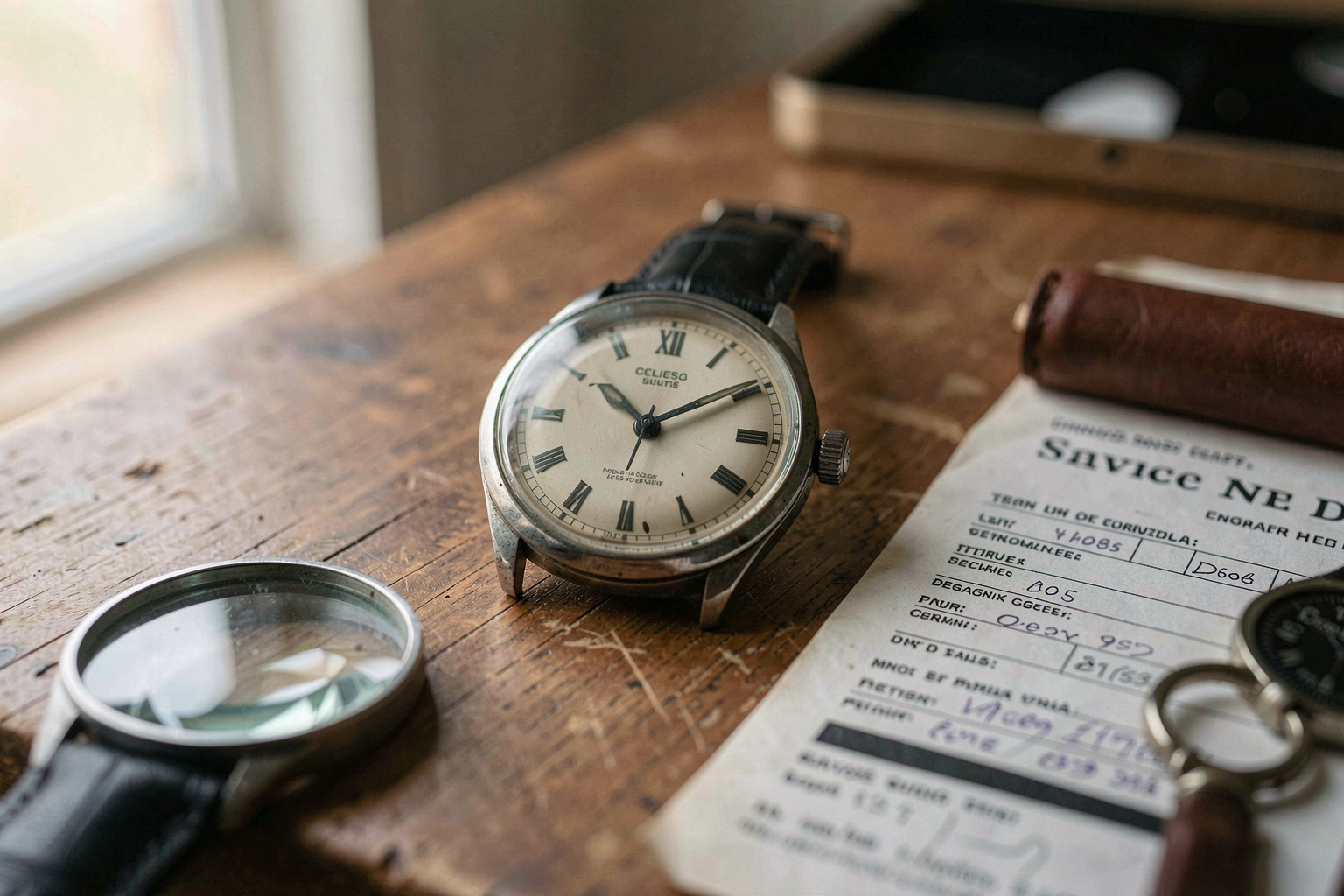
The service record shows what a watchmaker has done. A dated invoice for a full service, with a note on parts replaced, is the strongest single document a seller can produce. It cannot prove the watch has never been dropped, and it cannot prove the movement is currently running to specification.
A buyer who runs all three checks has a clear picture of what the watch is. A buyer who runs none of them is guessing.
A small group of houses dominates the second-hand trade, and each name means something specific to a buyer.
Rolex holds value because demand is global and the reference history is well documented. The Datejust is the clearest example: its case and bracelet changed at least five times since 1945, and those changes are the fastest way to place an example in time before anyone quotes a price for it. A buyer who can date a Datejust by its case profile and bracelet style has an advantage in every negotiation.
Patek Philippe holds value through scarcity and through the archive. The company keeps records of every watch it has made, and a certificate from that archive raises the price of an old piece considerably.
Audemars Piguet, Vacheron Constantin and Omega each occupy a different tier. Omega sits at the accessible end, with a large production and a strong parts supply, which makes servicing easier and prices steadier. The other two sit higher, with smaller production and longer waits for parts.
Brands outside this group can still be excellent watches. They simply do not carry the resale premium, and a buyer should price them accordingly.
A complete set includes the original box, the warranty card or certificate, the instruction booklet, and any service invoices. The warranty card matters most, because it carries the serial number and the date of sale, and it links the watch to a specific dealer.
A watch sold without papers is not necessarily a bad watch. It is a watch with a thinner history, and it should cost less than an identical example with a full set. The gap is usually between ten and twenty per cent, and it widens for rare references where collectors pay for completeness.
Service invoices are the second most useful document. They show that someone cared for the watch, and they name the parts that were replaced. A watch with a recent service and a note that the original dial was retained is worth more than one with an undocumented overhaul.
A mechanical watch runs on a mainspring, and the mainspring prefers to be used. A watch left in a drawer for a year will need a service sooner than one worn twice a week.
For a hand-wound watch, wind it fully once a day at roughly the same hour. For an automatic, wear it or place it on a winder. A winder is not essential, but it keeps the movement running and the lubricants spread.
Store watches away from direct sunlight, which fades dials, and away from magnetic sources such as speakers and tablets. Humidity is the enemy of steel cases and leather straps, so a dry box with a silica pack is enough for most collections.
When travelling, carry the watch on the wrist or in a soft pouch. A hard case protects against impact but can press on the crown if the watch shifts. A pouch inside a bag is usually the safer arrangement.
A fair price is the market price for that reference in that condition with those documents, minus a discount for anything missing. Buyers can build a picture from completed auction results, dealer listings and forum sales, and the three sources rarely agree exactly.
A watch priced well below the market usually has a reason: a refinished dial, a replaced movement, a stolen history or a seller who needs cash quickly. A watch priced well above the market usually has a story attached. Neither is automatically wrong, but both deserve a slower read.
The buyer who checks the reference, the serial, the service record and the documents before discussing price is the buyer who ends up with a watch worth keeping.